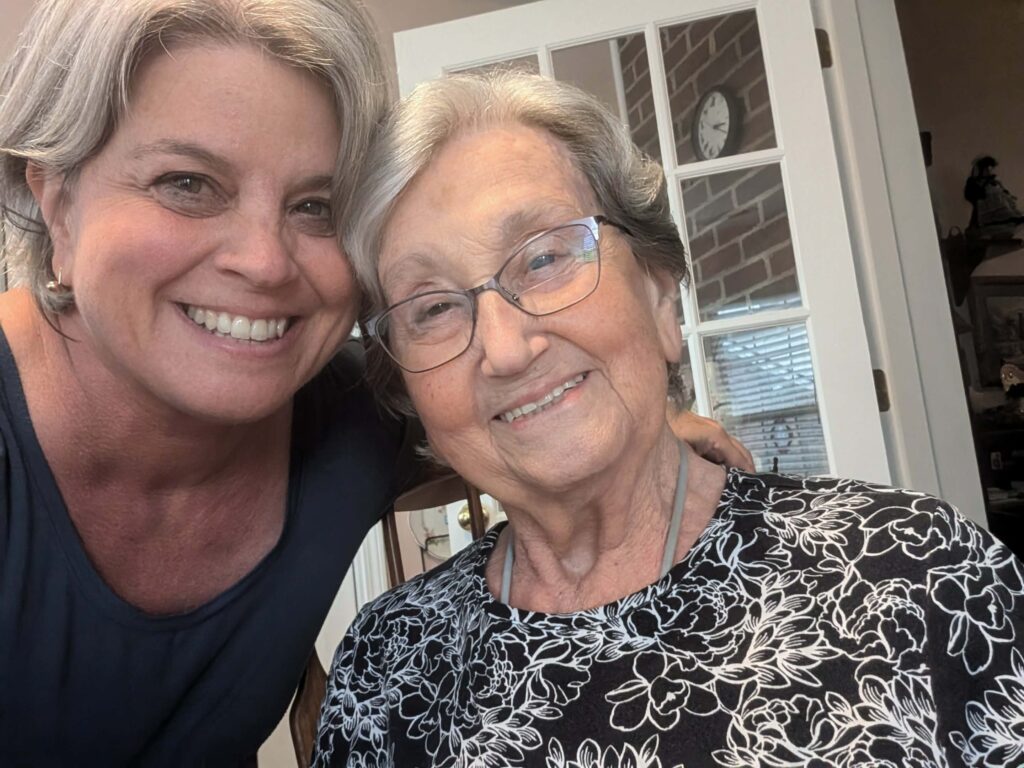
When Caring for Mom Gets Too Heavy: Jen’s Story
- Hospice
- Patients and Families
- Stories
For the women holding it all together—until it’s too much.
If you’re part of the “sandwich generation,” you know the feeling: you’re managing work, your own household, and the quiet (or not-so-quiet) realization that your parent is needing more—more help, more attention, more care. You want to do it with love. You want to do it right. And you don’t want to let anyone down.
Jen was in that place, too—determined to care for her mom at home, and convinced she just had to push through.
“I was taking care of mom, and her care became too much for me,” Jen shared. “I couldn’t do it by myself anymore…it was a little frightening for me.”
That moment—when you realize love and willpower aren’t enough to cover the practical demands of caregiving—can bring a particular kind of fear. Not because you don’t want to be there for your parent, but because you’re trying to hold an entire system together with your own two hands.
“This team of people came in…and they helped me in ways I didn’t know were available.”
Jen finally made the call for hospice care. What happened next surprised her—not just because help arrived, but because it wasn’t one person with a checklist. It was
a whole team.
“I called hospice, and this team of people came in…and they helped me in ways that I didn’t know was available to me,” she said. “And they made my mom feel better, which made me feel better. And it was such a relief…to have such wonderful people on my side.”
One of the biggest gifts wasn’t just physical care—it was emotional breathing room. “They relieved me of so many of the responsibilities that was scaring me,” Jen explained. “And they made it possible for me to be my mom’s daughter again and not just her caregiver.”
When her pain was managed, “she became part of our family again.”
Jen noticed the difference quickly. “Once her pain was better managed, she became part of our family again,” she said. “She started being able to come to the table, and eat with us and laugh with us…it was great to see that little bit of life in mom return.”
With support in place, Jen got time back—time that didn’t feel like tasks and alarms, but like being together. “We started spending lots and lots of time…going through pictures,” she remembered. “I wanted to know all the history before she forgot. Hospice helped that happen for me. They improved her life so much that she felt like doing that with me.”
“Hospice isn’t just end-of-life care” — what families misunderstand
Like a lot of people, Jen didn’t realize how much help hospice can provide. “It’s not end-of-life care,” she said emphatically. “They do so much more than that.”
For Jen, the difference was practical and personal: guidance, symptom and comfort support, supplies, and a steady team she could lean on—so she wasn’t making every decision alone at 2 a.m. “The relief to know that I qualified for hospice was life-changing,” she said.
“There must be five or six people on this team,” Jen said. “And they become your family.” She still smiles remembering one caregiver in particular: “Kim would come in and say, ‘Hello, my beautiful one—are you ready for your spa day?’ And my mom always lit up when they came in…It’s a beautiful thing to watch your mom trust and love on the people who are helping you so much.”
If you’re trying to do this alone, you’re not the only one.
Jen is quick to say what so many caregivers feel but rarely say out loud: “It’s hard—it’s very hard—to be a caregiver. It’s very overwhelming. It’s very scary.” And it’s happening to more of us. Our parents are living longer, and many daughters find themselves coordinating medications, meals, appointments, falls, finances, and family dynamics—while still trying to keep their own lives afloat.
Jen always expected she’d be involved in caring for her parents. “It was an honor and a privilege,” she said. “But there came a day where I knew I was limited on what I could do for them, and I wasn’t going to be able to do it all by myself.”
A gentle encouragement from Jen: call sooner, not later.
Looking back, Jen wishes she’d known earlier what support was available. “I wanted everybody to know…don’t wait to call. Call sooner rather than later,” she said.
If you’re caring for a parent and you’re exhausted, worried, or unsure what’s next, you don’t have to wait for a crisis to reach out. Hosparus Health can help you understand options, reduce the load you’re carrying, and bring comfort and support not just to your loved one—but to you and your entire family.
You deserve support, too. And your parent deserves more good days—days that feel like family.